
Russell Projected Versus Actual Release
KDOC uses the precise term anticipated guidelines release date. “Anticipated” signals that the date is a current sentence calculation, not a promise of release at a set hour. Credits, forfeitures, sentence aggregation, court action, or another lawful change may alter it. The actual release is a later movement or status event showing that custody changed.
County jail cases work differently. A person held before trial has no sentence-based projected release date. Release may follow bond, dismissal, a court order, time served, or another agency taking custody. Even after a judge signs an order, jail staff must receive and process it. The court record explains the legal authority, while the Russell County Sheriff’s booking and release record supplies the physical exit date and time.
- Anticipated guidelines release date
- KDOC’s public label for a provisional calculated release date under the Kansas guidelines framework.
- Conditional release
- A statutory release point that can differ from parole eligibility, an anticipated guidelines date, and sentence expiration.
- Expiration
- The end point of the sentence calculation. It does not mean every person remained confined until that date.
- Discharge
- The end of the correctional sentence or supervision, which can occur after release from prison.
Find a Russell Release Projection
Use KASPER only when the person is associated with a KDOC-funded or operated program. It covers Kansas prison custody, parole, postrelease supervision, and relevant correctional data. It is not a complete archive for a person whose custody began and ended only at Russell County Jail.
- Open the official KASPER disclaimer, read it, and accept the terms. Offender and absconder data update each working day rather than continuously.
- Search by KDOC number for the clearest match. If it is unknown, use the name and narrow by birth date or age, gender, race, or conviction county. An alias search can help when the record uses another name.
- Compare the result’s name, date of birth, KDOC number, physical identifiers, convictions, and case information. A name alone is not enough.
- Open the detail and distinguish the anticipated guidelines release date from sentence-begins, parole-eligibility, conditional-release, expiration, and movement dates.
- For Russell County jail custody, contact the Sheriff at 785-483-2151 and review the district-court case. Request the release date and time, event type, authority, and receiving agency if the person was transferred.
The KASPER search and released-result source shows the state interface and its sentence fields.
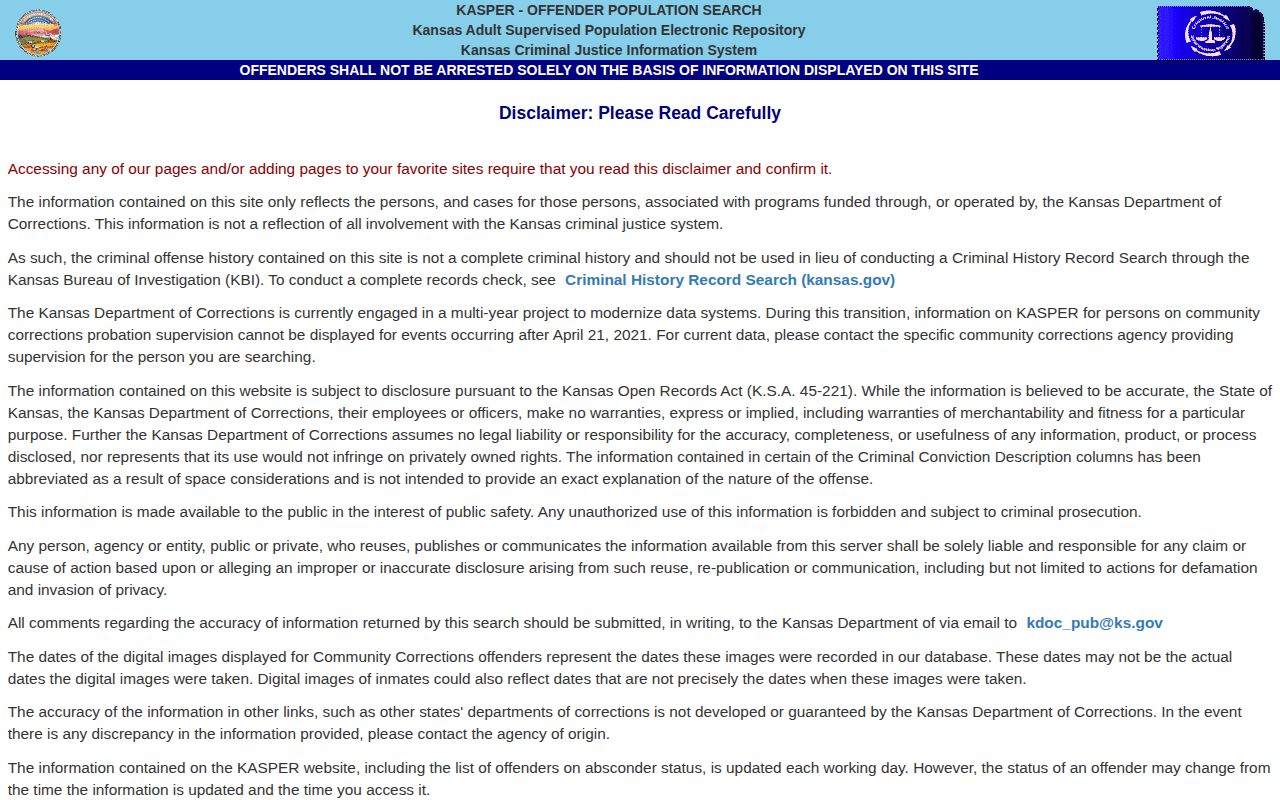
The screenshot illustrates why identity, status, sentence dates, and movements must be read together instead of relying on a single date.
Russell State Release Date Fields
KDOC’s public records materials identify several sentence fields. Each answers a different question. A past anticipated date does not prove that the person physically left prison on that date, and a parole-office location indicates supervision in the community rather than confinement at the office.
| KDOC field | What it means |
|---|---|
| Sentence begins | The formal start used in the sentence record. |
| Parole eligibility | The point when an eligible indeterminate case may be considered, not a promised release. |
| Anticipated guidelines release | A provisional computed date for an applicable guidelines sentence. |
| Conditional release | A separate release milestone set by the governing sentence law. |
| Expiration | The calculated end of the sentence term. |
| Movement or actual status | Evidence of what custody or supervision change was processed. |
When formal historical proof is needed, use the KDOC public records request portal to seek existing movement, release, and sentence-computation fields. If final discharge matters, ask for the existing order or certificate rather than assuming release from confinement ended all supervision.
K.S.A. 45-221(a)(29) identifies public KDOC record categories that can include conviction and sentence data, parole-eligibility information, custody or supervision level, facility and parole-office location, and specified supervision information. The KDOC disclosure brochure also identifies sentence-begins, anticipated guidelines release, conditional-release, expiration, and movement information. Public availability does not make those labels interchangeable. Each field should retain the name KDOC gave it.
A final discharge can require different proof from an actual prison release. K.S.A. 22-3722 permits a final order or certificate of discharge after qualifying service on parole or conditional release. Thus, a person may have an actual movement out of prison, a later span of community supervision, and a still later discharge record. The date requested should match the event that needs confirmation.
Russell Release Credits and Limits
Kansas good-time rules depend on the offense date, sentence type, crime severity, and governing statute. For many determinate sentences, K.S.A. 21-6821 sets a maximum good-time credit of 15 percent. Specified lower-severity categories can have a 20 percent maximum. The statute also allows up to 120 days of program credit in eligible cases. These are ceilings, not automatic reductions for every person.
Credits may be earned through conduct and eligible programming, then withheld or forfeited under the rules. Sentence aggregation and later court action can change the computation. A simple “serve 85 percent” shortcut may describe one common maximum-credit result, but it is not a valid personal calculation. Subtracting 15 percent from the announced sentence ignores jail credit, multiple counts, consecutive terms, forfeitures, sentence dates, and exceptions.
Older indeterminate cases, especially those tied to pre-1993 law, use a different framework. Parole eligibility under K.S.A. 22-3717 can depend on the minimum term less applicable good time and numerous exceptions. Off-grid sentences and specified murder categories can carry special rules. Life without parole is not converted into a projected release date. The sentence journal entry and KDOC calculation control.
County jail credit was not verified in the bounded Russell County research. Do not apply the KDOC percentage to a local jail term. The court and Sheriff should be asked for the existing calculation and release record.
Why Russell Release Dates Change
A release projection changes only through an authorized correctional or court process. Some factors move the calculation. Others change where the person goes without changing the sentence date itself.
| Factor | Possible effect | Record to check |
|---|---|---|
| Credit earned or forfeited | Changes an eligible sentence computation | KDOC sentence record |
| Program credit | May reduce an eligible term within the statutory cap | KDOC computation |
| Court correction or new sentence | Changes the legal terms or aggregation | Journal entry and KDOC update |
| Parole action | Can affect an indeterminate case, subject to plan review and final processing | PRB order and later KASPER movement |
| Detainer or warrant | May cause transfer to another authority instead of community release | Receiving-agency and movement record |
| Processing lag | Delays what appears in a working-day public update | Direct agency confirmation |
A detainer is a request or notice from another authority concerning custody. When Russell County or KDOC transfers a person under a warrant or detainer, the first agency’s custody may end while confinement continues elsewhere. Record the event as a transfer or release from the named agency, not as proof the person returned to the community.
Russell Parole Is Not Projection
The Kansas Prisoner Review Board publishes prospective public-comment and hearing schedules for applicable cases. A scheduled hearing shows possible consideration. It does not show a grant, a physical release date, or the final result. The board can parole, pass, or continue a case, and an announced grant may still be rescinded before release.
Most post-1993 determinate guidelines prisoners proceed to mandatory postrelease supervision rather than discretionary parole. For an indeterminate sentence, compare the prospective schedule, any board order obtained through KDOC, and later KASPER status. A favorable action may still require an approved release plan before physical release. The Russell County Probation & Parole page explains how to distinguish state supervision from court probation after custody ends.
A parole-office location in KASPER is evidence of a supervision relationship. It is not a place of incarceration and should not be described as the releasing facility.
Confirm a Russell Actual Release
For state custody, look for a processed movement or current status in KASPER after the anticipated date. Because KASPER updates each working day, a same-day absence is weak evidence. Request the official KDOC movement or release record when exact timing or durable proof matters.
For Russell County Jail, call the Sheriff and ask a narrow question: whether the person remains held, was released, or was transferred, and on what date. Then request the booking and release entry. Compare it with the Russell County District Court bond, dismissal, sentencing, probation, or discharge order. The court explains authority; the jail record confirms the exit.
Kansas VINE can provide an alert for an adult county-jail custody change, including release or transfer. It does not cover KDOC prison offenders. Use the VINELink Inmate Search only for its county-jail scope, and preserve any alert before seeking the sheriff’s durable record. Federal BOP and ICE results are also limited to their own systems.
A records request should identify the person with a full name, date of birth or other useful disambiguator, and an approximate booking or sentence date. For a county event, ask for the existing booking and release register entry or equivalent report. Requested fields may include the admission and release times, event type or authority, charges and case number, bond status, and receiving agency for a transfer. This wording asks for existing records rather than requiring staff to create a new calculation.
Kansas open-records law requires agency action as soon as possible and no later than the end of the third business day. That is a response rule, not a promise that the record will be produced within three days. An office may seek clarification, charge reasonable actual costs, require advance payment, or withhold protected fields while releasing separable public portions. No verified Russell jail retention period or local fee schedule was found, so neither should be inferred from the age of an online result.
Keep the agency boundary in the final wording. A BOP date proves release from BOP custody only. An ICE result is limited to ICE custody, and a KASPER release does not by itself prove that state supervision ended. The strongest statement names the agency, processed event, date, and any receiving authority.