
Kansas Corrections Release Paths
The Kansas Department of Corrections operates adult state correctional facilities. Its official index identifies no state prison in Russell County. A Russell County conviction does not assign a person to nearby Ellsworth Correctional Facility, which is in Ellsworth County. KDOC chooses placement through statewide classification and can move a person as needs change.
Leaving prison and ending a sentence are not the same event. A person may leave confinement for parole, mandatory postrelease supervision, or conditional release. An expiration or final discharge ends a different legal stage. A parole-office location in KASPER describes community supervision, not confinement at that office.
| State event | Meaning | Evidence |
|---|---|---|
| Prison release | Physical KDOC confinement ended | KASPER movement/status and KDOC record |
| Parole | Community supervision after an indeterminate sentence | Board action, KASPER, parole record |
| Postrelease | Required supervision following many determinate sentences | Sentence and KDOC supervision fields |
| Final discharge | Correctional sentence or supervision ended | KDOC discharge order or certificate |
Confirm Kansas Corrections Release
Start with the official KASPER disclaimer and entry. The repository covers people and cases associated with programs funded or operated by KDOC. It is not a complete archive of every person held only in Russell County Jail.
- Accept the disclaimer and search by KDOC number when known. That identifier is more precise than a name.
- Otherwise use first and last name, then narrow with birth date or age, gender, race, or conviction county. Include aliases when appropriate.
- Compare the KDOC number, birth information, physical identifiers, convictions, and cases before attributing a result.
- Read status, location, sentence, movement, release, and supervision fields together. Do not turn an anticipated date into an actual release.
- Request the official movement or discharge record when a formal historical answer is needed.
KASPER states that offender and absconder data updates each working day, not continuously. A recent transfer can take time to appear. A blank result may also mean the case was jail-only, the spelling differs, or the wrong system was searched.
Kansas Corrections Search Fields
KASPER supports a broader identity check than a simple name box. Advanced options include KDOC number, KBI number, conviction county, aliases, demographics, and an SSN match that returns only yes or no. Sensitive identifiers should not be published.
| Field | Best use | Caution |
|---|---|---|
| KDOC number | Precise record match | Verify the digits |
| Name and alias | Initial discovery | Common names need more proof |
| Birth data | Identity comparison | Use lawfully and discreetly |
| Conviction county | Narrow to a Russell case | It is not the facility location |
| Photo option | Resolve identity | Image date may not equal taking date |
The official KASPER search interface shown below illustrates the statewide route.
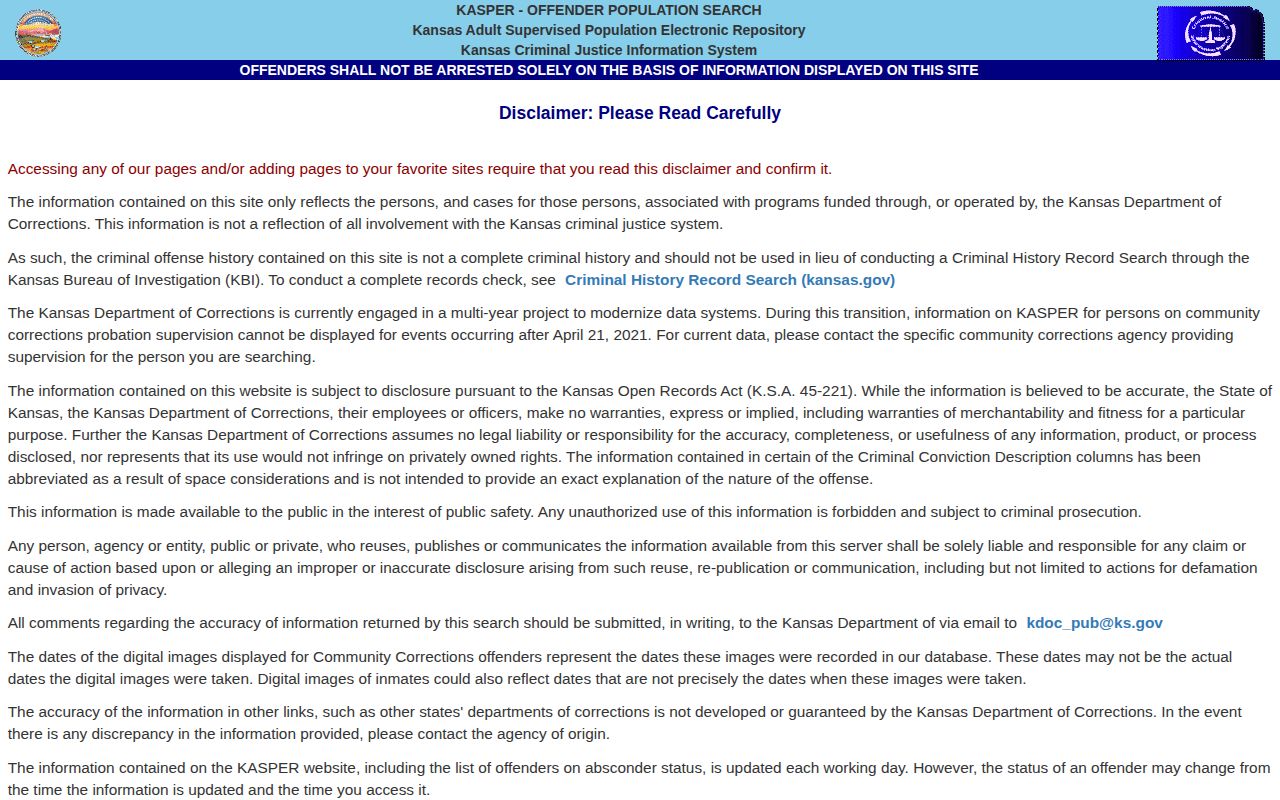
The interface searches KDOC data. It does not query the Russell County Sheriff's booking/release register.
Kansas Corrections Release Dates
KDOC uses several date fields that answer different questions: sentence-begins date, parole-eligibility date, anticipated guidelines release date, conditional-release date, actual movement or release date, expiration date, and final supervision discharge. A past anticipated date alone does not prove release on that date.
“Anticipated guidelines release date” is intentionally provisional. Credits, forfeitures, sentence aggregation, court action, program credit, and statutory exceptions can alter a calculation. Never subtract a flat percentage from a sentence to announce an individual's release. Older pre-1993 sentences and exceptional or off-grid cases follow different frameworks.
For final discharge, K.S.A. 22-3722 recognizes a discharge order or certificate after qualifying parole or conditional-release service. A released KASPER record can still show active supervision. Preserve the exact state term instead of using “free” or “fully released.”
Kansas Corrections Records Request
Use the KDOC GovQA portal for a formal request. Provide the full name, KDOC number, and date of birth. Ask for existing movement/release history, sentence-computation fields, the final discharge order or certificate, and an institutional photograph when relevant.
Kansas Department of Corrections714 SW Jackson, Suite 300
Topeka, KS 66603
Phone: 785-296-3317
The KDOC KORA brochure and K.S.A. 45-221(a)(29) identify public correctional categories that can include identifiers, photograph, conviction and sentence information, parole eligibility, custody or supervision level, facility or parole-office location, and specified supervision information. Other material may be closed. Segregable public parts should be released after protected matter is removed.
No exact KDOC retention period was verified. Kansas open-records law applies to records that exist and does not itself create a retention term. Ask whether the requested period remains available.
Kansas Corrections Supervision Limits
KASPER is useful for parole and postrelease status, but it is not a complete probation lookup. Its disclaimer warns that community-corrections probation events after April 21, 2021 are not currently displayed during modernization. Court Services and Central Kansas Community Corrections may hold the current answer for a Russell probation case.
Use the official parole-office directory to identify the responsible office. Do not assume Russell County reports to the nearest office. The automated parole reporting number is 866-570-7225.
A parole-absconder result is a supervision warning, not proof of current jail custody. A scheduled-offender entry from the Prisoner Review Board shows eligibility for consideration, not a grant or physical release. Confirm later action in KASPER or through KDOC records.
Kansas Corrections Versus Jail
Russell County Jail and KDOC are separate custody systems. A sheriff release entry documents the end of the local jail episode. KASPER becomes relevant after state commitment and intake. Kansas VINE covers participating adult county jails and expressly excludes KDOC state prisons.
If a Russell court judgment orders prison, use the court record to establish the commitment, then allow processing time before searching KASPER. If the person never entered KDOC, a missing state result does not disprove the county jail stay. The Russell County release search explains how the sheriff, court, and state records fit together.
Conviction county, prison location, parole-office location, and current residence are four different fields. Do not infer one from another.
Kansas Parole Decision Evidence
The Kansas Prisoner Review Board handles parole questions for eligible indeterminate cases. Its public-comment calendar and scheduled-offender list are prospective tools. A listing means the person is scheduled or eligible for consideration. It does not show that parole was granted, a release plan was accepted, or the person passed through the prison gate.
Board terminology also matters. KDOC explains that the board may parole, pass, or continue a case. Even a favorable action may precede release-plan approval and can be rescinded before physical release. Confirm the later event through KASPER movement data or request the board action from KDOC.
Many post-1993 determinate guidelines prisoners proceed to mandatory postrelease supervision rather than discretionary parole. Offense date and sentence law control. Do not label all Kansas prison departures “parole.”
Correct Kansas Corrections Errors
KASPER publishes a direct accuracy channel at kdoc_pub@ks.gov. Use it when a public KDOC entry appears to contain an identity, status, or record error. Describe the issue precisely and avoid sending more sensitive information than the agency needs.
That address is not the correction route for a Russell County jail entry or a district-court order. Direct a county booking or movement error to the Sheriff's Office. Direct a case-document error to the issuing court. The agency that created the field is best placed to review it.
KASPER information can change after access. Record the date checked, keep the official wording, and revisit the current source before relying on a time-sensitive status.
KDOC's public categories are broader than one status line. They may include sentence-begins data, anticipated guidelines release date, conditional release, expiration, custody level, movement, facility location, parole-office location, identifiers, and an institutional photograph. Request only the existing fields needed to answer the release question.
An institutional photograph is not a Russell County Jail booking photo and may not depict the person on the release date. KASPER warns that an image record date can differ from the date the photograph was taken. Label the source and date precisely.
Preserve Kansas Release Proof
When a date or movement matters for a court or records purpose, preserve the KASPER result and request the underlying KDOC record. The repository is a public access tool, while the agency record supplies the more durable response. Record the search date because the public status can change after access.