
Federal Custody Release Routes
Federal custody serving a Russell County matter is a system layer, not a physical facility in the county. The bounded official-source review found no federal prison in Russell County. A federal defendant may still spend time in a local or regional jail under a USMS arrangement.
USMS manages federal defendants from court-ordered detention until acquittal, judicial release, or delivery to BOP after commitment. Transport to another contract jail or courthouse continues custody. A federal judge's order is the source for pretrial release, while the docket supplies conditions and later case events.
BOP becomes the primary public locator for sentenced federal custody. Its public records generally cover federal inmates from 1982 forward. A displayed past release date describes release from BOP on that date. It does not rule out federal supervised release, state custody, immigration custody, or another hold.
| Federal stage | Primary source | What it can establish |
|---|---|---|
| Pretrial detention | Federal docket and USMS | Court authority and custodian |
| Sentenced imprisonment | BOP locator | BOP facility/status and listed release date |
| Local jail handoff | Sheriff release/transfer entry | Receiving agency and local exit |
| Supervised release | Federal judgment and docket | Community supervision term |
Confirm Federal Custody Release
Begin with the source that fits the federal stage. Do not use KASPER or Kansas VINE as a substitute. Those services cover Kansas state corrections and participating Kansas county jails, respectively.
- Ask the Russell County Sheriff's Office whether its record identifies USMS, BOP, or another federal receiving agency. Request the event date and destination.
- Search the federal court docket for a detention, release, acquittal, sentencing, commitment, or supervised-release order. The docket controls the judicial event.
- For a sentenced person, search the BOP Inmate Locator by federal number when known or by name plus identifying traits.
- Compare identity and read the BOP status literally. “Released” means released from BOP custody, not necessarily free of all custody or supervision.
- If a result is unclear, use the BOP record guide and the issuing court rather than guessing from absence.
A USMS transport may never create a BOP locator entry if the person was not committed to a BOP sentence. USMS has no public historical prisoner locator and restricts movement timing, histories, and photographs. The federal docket is therefore essential for a pretrial case.
Search Federal BOP Records
The BOP locator accepts a BOP register number, DCDC number, FBI number, or INS number. A name search can be narrowed by race, sex, and age. An agency identifier usually produces a cleaner match than a common name.
The official BOP search interface shown below includes both current and released results.
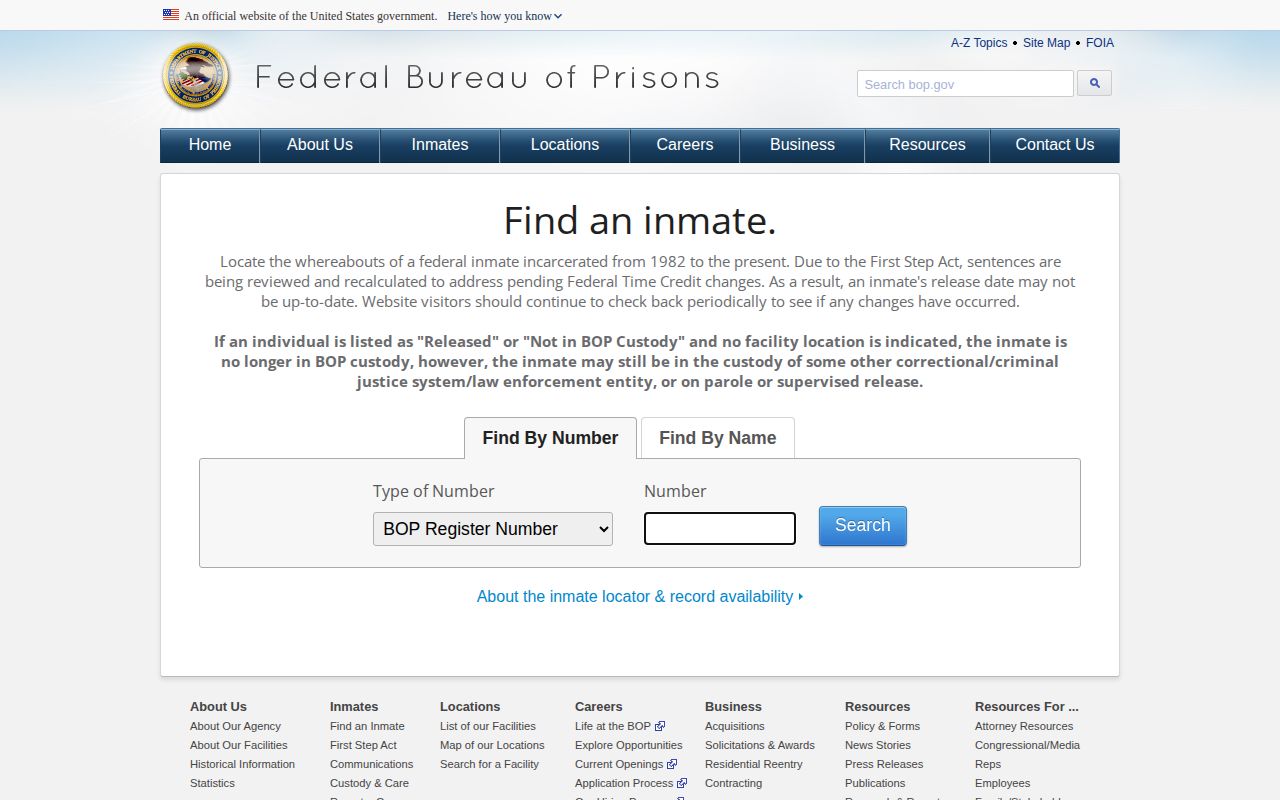
The locator describes BOP custody only. It does not confirm a release from Russell County Jail or a federal judge's pretrial ruling.
Search results may show a current facility, a release date, “Released,” “Not in BOP Custody,” or “UNKNOWN.” The BOP record guide explains that a past release date with no facility indicates release from BOP. “UNKNOWN” means the confinement term is undetermined, not that release occurred.
Read Federal Release Results
A federal release date needs a system label. Write “released from BOP custody on the listed date,” not “fully released.” The person may begin federal supervised release, answer another jurisdiction's warrant, enter state custody, or be transferred to immigration custody.
The BOP record and release-status guide is illustrated below. It helps distinguish a historical BOP event from a claim about the person's complete legal status.
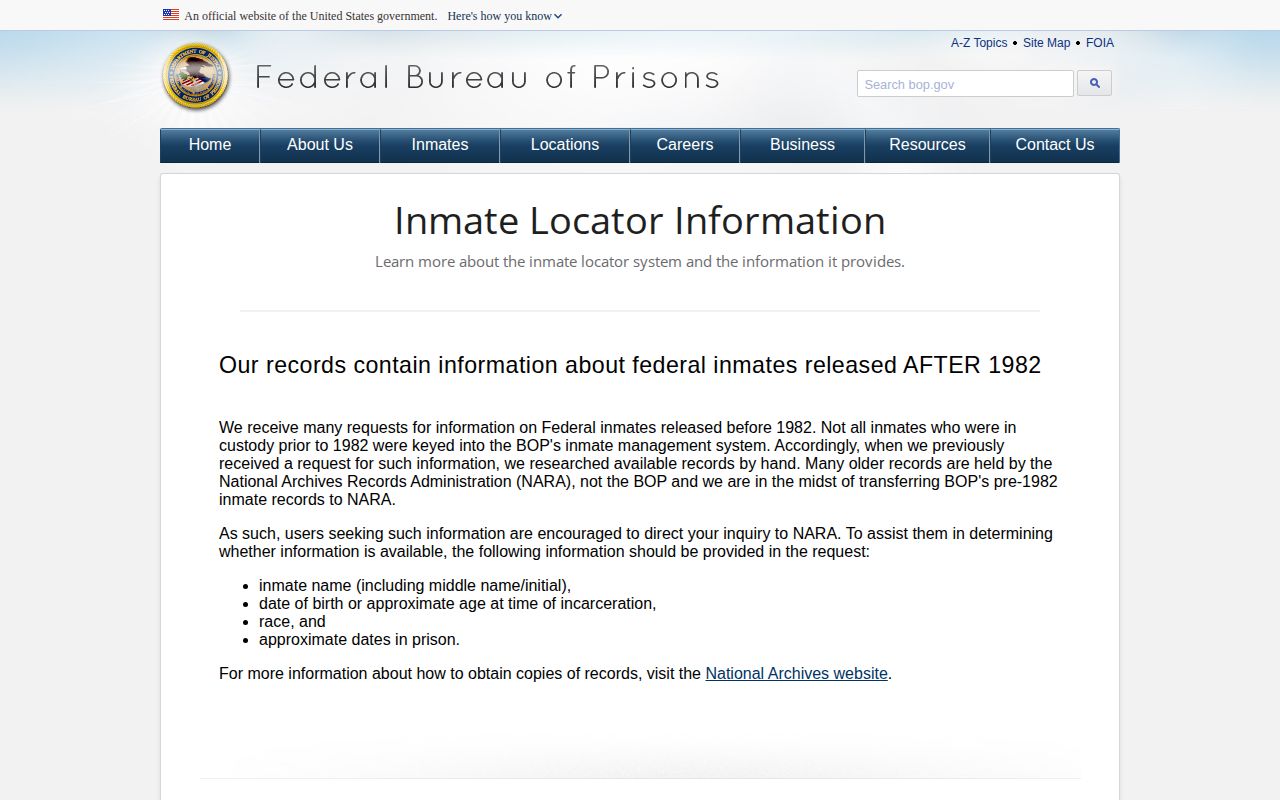
Read that guidance together with the current result and federal docket. Do not use an old screenshot to state a person's present status.
- Released from BOP
- The BOP incarceration episode ended on the displayed date.
- Not in BOP Custody
- BOP does not currently hold the person; another custodian may.
- Federal supervised release
- Court-ordered community supervision after imprisonment, separate from BOP confinement.
- USMS transfer
- Movement within federal pretrial custody, not release by itself.
Federal Records and Contact Limits
No Russell County federal facility address or federal release desk was verified because no such facility was located in the county. For a local handoff, direct the local record request to the Russell County Sheriff's Office at 210 E. 4th Street, Russell, KS 67665, phone 785-483-2151. Ask for the destination or receiving-agency field if present.
For the legal basis, use the federal court docket. A detention order, release order, judgment, or supervised-release term may be public unless sealed or otherwise restricted. Court staff can explain record access but cannot provide legal advice.
BOP and USMS access rules differ. The BOP locator is a public status tool. USMS restricts prisoner history, photographs, and movement timing and offers no former-prisoner search. A request cannot compel an agency to create a record or disclose protected security details.
Federal Versus Russell Release
Russell County Jail can record a person as transferred to a federal authority. That entry ends the local custody episode but does not establish community release. Pair the sheriff event with the federal docket and, after federal sentencing, the BOP locator.
A BOP release cannot prove the person was ever held in Russell County. Likewise, disappearance from a county roster cannot prove BOP accepted custody. The Russell County search path starts with the agency that last had verified custody and moves forward one handoff at a time.
Use “released” only with the agency whose custody ended. A receiving agency can begin custody at the same handoff.
Federal and Immigration Handoffs
Federal criminal custody and civil immigration custody are not interchangeable. BOP is part of the federal criminal correctional system. ICE manages immigration detention. A person leaving BOP could still face ICE custody, but the BOP result will not answer that question.
When a record mentions ICE, detainer, or an A-number, use the ICE locator promptly. Its former-detainee visibility is limited. When the record mentions USMS or a federal criminal case, prioritize the federal docket. Exact agency wording prevents a transfer from being reported as a return to the community.
No official source established a Russell County ICE detention contract or federal prison. These routes are conditional fallbacks supported only when a case, warrant, detainer, or receiving-agency field points to them.
Federal Custody Identity Checks
A name match in the BOP locator is not enough. Compare the register number, age, race, sex, sentencing information, and court case when those details are lawfully available. Aliases and spelling differences can hide a record, while common names can point to the wrong person.
The conviction or arrest connection to Russell County does not mean confinement occurred there. No federal institution is located in the county. A sentenced person can be placed anywhere BOP determines appropriate, and a pretrial defendant can be housed under contract outside the district.
Record the search date and quote the status exactly. BOP data can change as a sentence is recalculated, a person moves, or custody ends. A historical result should not be presented as current without checking again.
Federal Release Record Pairing
A strong federal release confirmation identifies the custodian, event date, event type, and any next legal stage. For a pretrial release, pair the court order with docket activity. For a BOP sentence, pair the locator's release date with the judgment or a BOP record when formal proof is needed.
Supervised release is imposed by the sentencing court and follows incarceration in many cases. It is not parole and should not be confused with Kansas KDOC parole or postrelease supervision. A violation can return a person to federal custody through a new court action.
If the person first left Russell County Jail, keep the sheriff transfer entry with the federal sources. Together they show where local custody ended and how federal custody began. Neither record alone necessarily describes the whole chain.
A federal judgment can impose imprisonment and a later supervised-release term in the same document. Read both parts. The end of BOP imprisonment may start court supervision rather than end the federal sentence structure. If revocation later occurs, the docket supplies new judicial authority and the locator may show renewed custody after processing.