
Russell Parole and Probation Types
Parole, postrelease supervision, Court Services probation, and community corrections are separate legal statuses in Russell County. Parole is supervised release that applies to certain prison sentences, often older indeterminate sentences with a minimum and maximum term. Postrelease supervision follows many determinate Kansas guidelines sentences. Probation is ordered by a court as part of the criminal case and may allow a person to remain in the community instead of serving all or part of a jail or prison term.
The supervising source changes with the status. The Kansas Department of Corrections, or KDOC, administers parole and postrelease supervision. Kansas district-court Court Services handles court probation. Central Kansas Community Corrections serves assigned higher-risk felony cases in the 20th Judicial District, which includes Russell, Barton, Ellsworth, Rice, and Stafford counties. A release record should never be used to guess which branch applies.
| Status | How it begins | Best verification source |
|---|---|---|
| Parole | Release from an eligible prison sentence after board action | KASPER, KDOC records, and the parole office directory |
| Postrelease | Supervision required after many determinate prison sentences | KASPER and KDOC supervision records |
| Court probation | District-court probation order | Case docket, probation order, and Court Services |
| Community corrections | Court assignment to intensive felony supervision | Court docket and Central Kansas Community Corrections |
- Discharge
- The formal end of a correctional sentence or supervision term, not merely release from a facility.
- Absconder
- A supervised person reported absent from supervision. The label does not identify a current physical location.
- Revocation
- A court or correctional action that ends community supervision after a violation and may return the person to custody.
Verify Russell Post-Release Supervision
Start with the sentence rather than an address or a broad name result. A Russell County conviction does not mean the person was held in a Russell County state prison, and the nearest parole office is not necessarily the assigned office. Identity should be matched with a birth date, KDOC number, conviction county, or case number before any status is attributed to someone.
- Search KASPER through its official disclaimer when the person served a Kansas prison sentence. Use the KDOC number when known, or search by name and narrow the match with birth date, age, or conviction county.
- Open the detail and read status, movements, supervision level, and parole-office location together. An office location means community supervision, not confinement at that office.
- For probation, review the Kansas district-court case for the probation order, later revocation entries, and discharge. Contact Court Services or Central Kansas Community Corrections when the current assignment is not clear.
- Use the official KDOC parole office directory to identify the responsible office. Do not infer an assignment from geography.
- When formal proof matters, request the existing supervision, movement, or discharge record from KDOC or the court that created it.
The broader Russell County release search can help classify the original custody event before a supervision check begins. County jail release, state prison release, and a transfer to another agency need different evidence.
Russell Supervision Office Channels
KDOC publishes a statewide office directory instead of a verified Russell-to-Salina assignment. That distinction matters. The directory is the official way to find the office tied to a KASPER location or to ask where a parole or postrelease case is supervised. KDOC also operates the Parole Services Automated Reporting System at 866-570-7225 for people directed to use automated reporting.
Kansas Department of Corrections
Parole Services
Use the current statewide parole office directory for the assigned address and public phone number.
Automated reporting: 866-570-7225
KDOC Parole Office Contacts
Probation begins in the district-court record. Russell County District Court is at 401 N. Main Street, Russell, KS 67665, with mail directed to PO Box 876. Its public telephone number is 785-483-5641, and listed hours are Monday through Friday, 8 a.m. to 5 p.m. The clerk can explain access to public docket material, but the court does not replace a supervising agency for day-to-day status.
The official directory page shows how KDOC routes parole-office questions. The matching manifest image is introduced by the KDOC parole office contact source.
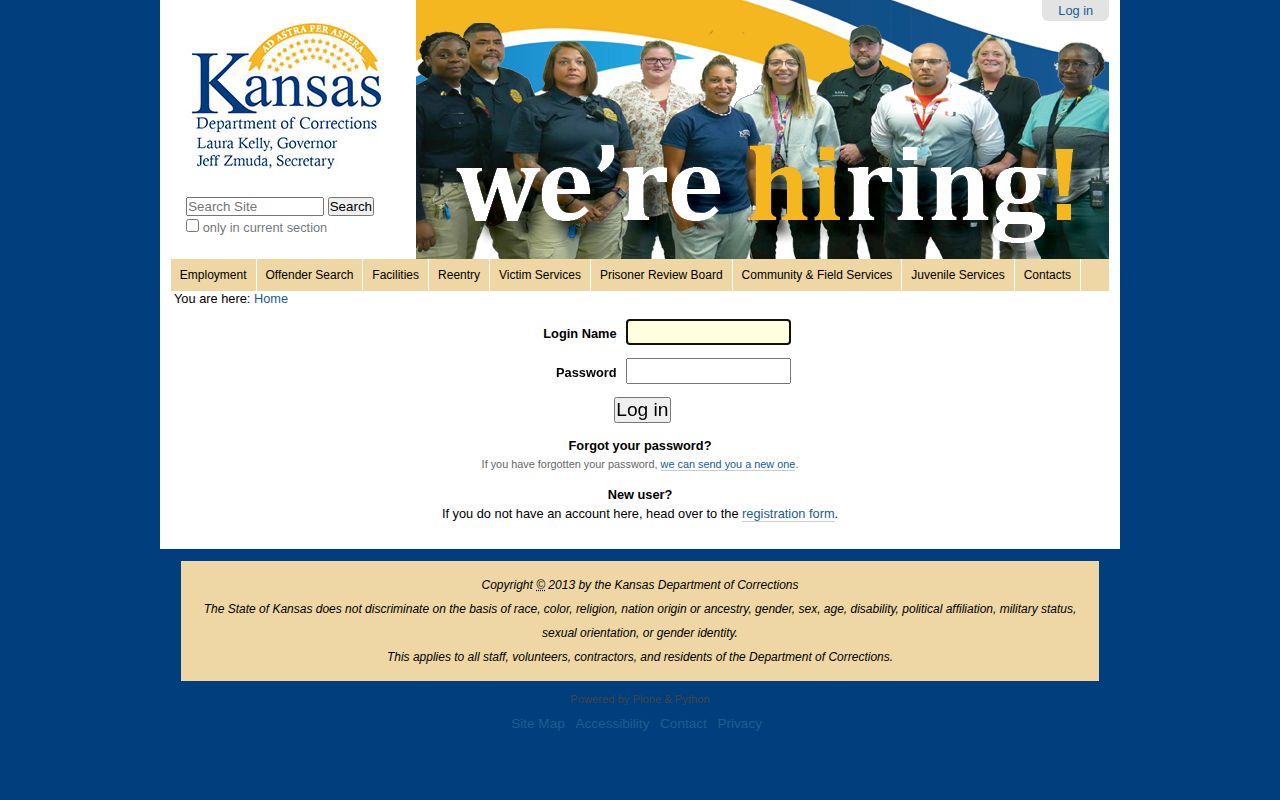
This directory should be checked when the office shown in a supervision record needs to be confirmed.
Russell Community Corrections Support
Central Kansas Community Corrections is the regional supervision layer for assigned higher-risk felony cases in Russell County and the rest of the 20th Judicial District. County minutes from March 2026 document KDOC funding and approved uses that include assessments, medication, transportation to treatment, help with sober-living expenses, and peer support. Those minutes establish that a regional supervision and support structure exists.
The funding record does not promise a particular service to any person. Eligibility, availability, court terms, and the assigned supervision plan control access. A person or authorized participant should ask the supervising officer about current options instead of treating a county budget item as a benefit list. This local distinction is especially useful when a probation order points to community corrections rather than Court Services.
For a current status, the district-court order and supervising agency remain the controlling channels. Meeting minutes document a program decision at a point in time; they do not establish an individual’s compliance, violation, or discharge.
Russell Parole Absconder Search
KASPER provides a dedicated parole-absconder search that allows Russell County to be selected as the last parole-supervision location. The interface may also display photos when that option is chosen. An absconder entry means KDOC reported the person absent from parole supervision as of the system update. It is not a Russell County warrant list, a list of all probation violations, or proof that the person is currently in the Russell County Jail.
The official KASPER parole absconder query should be rechecked before relying on a time-sensitive status.
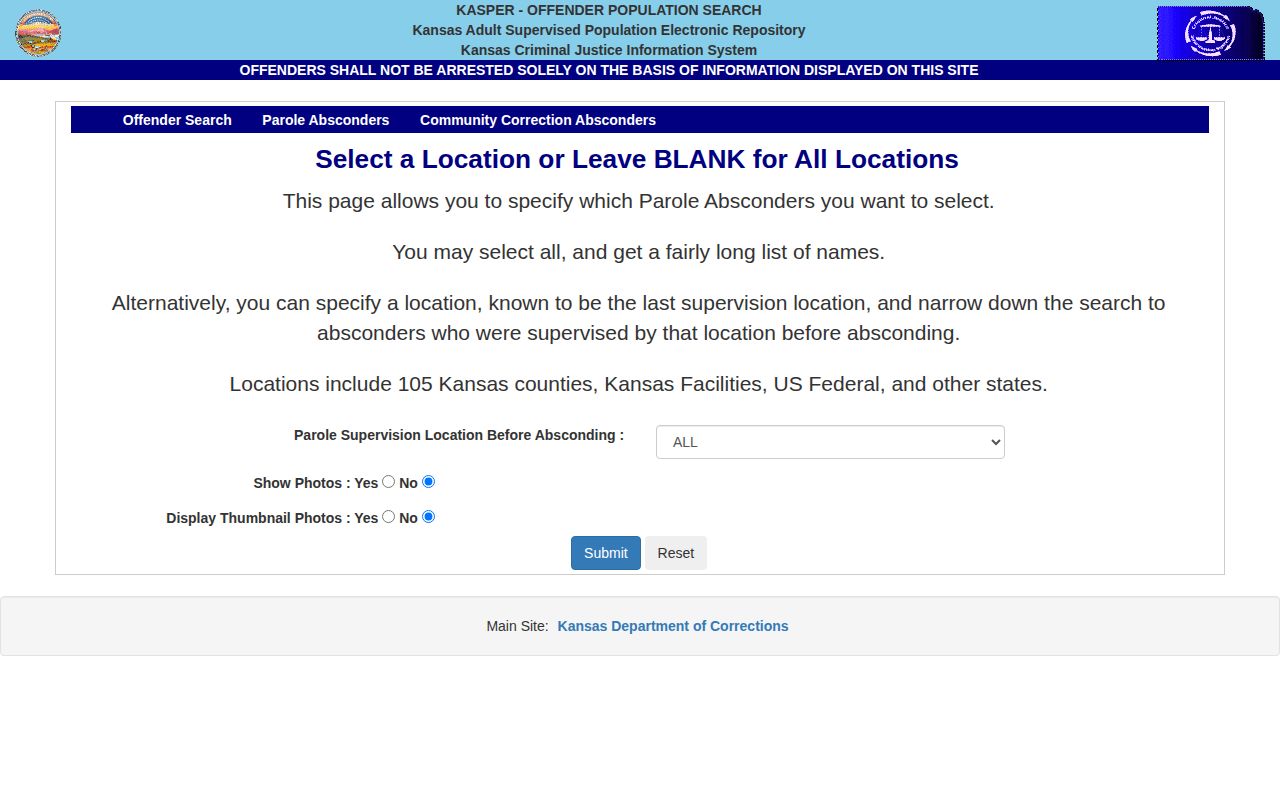
The county selector narrows the last supervision location, not the person’s present location or place of confinement.
If a person is later arrested on a KDOC warrant, both the county jail record and KASPER may become relevant. Describe only the event each current official source supports. “At large” should not be added unless an official current record uses that term and still supports it.
Russell Supervision Violations
Conditions are the rules attached to community supervision. They can include reporting, residence approval, treatment, travel limits, testing, or other terms found in an order or supervision plan. The exact terms belong to the individual record. A general search result does not reveal every condition, nor does an allegation prove a violation.
A suspected violation can lead to agency review, a warrant, arrest, or a revocation proceeding. Revocation is not automatic. For probation, the court docket is the durable source for a filed allegation and resulting order. For parole or postrelease, KASPER may show a custody or supervision change, while a KDOC record supplies stronger historical detail. Kansas VINE can report a county-jail custody event after an arrest, but VINE does not track KDOC prison custody or resolve the supervision case itself.
Release and legal status can coexist. An absconding report does not erase the historic fact that the person left prison. It changes the present supervision picture and may lead to new custody.
Correct Russell Supervision Records
KASPER publishes a direct accuracy channel at kdoc_pub@ks.gov. That address is appropriate when a public KDOC record for a released or supervised person appears wrong. A message should identify the record carefully, state the field in question, and point to a reliable supporting order or agency record without sending sensitive personal information that is not needed.
The source of the disputed fact controls the correction route. County jail booking or release errors should go to the Russell County Sheriff’s Office. Court disposition, probation, or discharge errors should be addressed through Russell County District Court. KDOC cannot correct a sheriff record merely because KASPER also refers to the person, and the sheriff cannot alter a state sentence computation.
KASPER updates each working day rather than in real time. A short delay may reflect update cadence instead of an error. A dated copy of the public result and the supporting official document can help an agency understand what was seen.
Russell Supervision Discharge Records
Release from a jail or prison gate is not the same as final discharge. A person can be outside a facility yet remain under parole, postrelease supervision, or probation. Final discharge ends the applicable correctional or court supervision term. Under K.S.A. 22-3722, a qualifying person on parole or conditional release may receive a final order or certificate of discharge. Determinate postrelease terms end under the sentence and governing law.
For state supervision, read KASPER status and movement fields together, then request the KDOC discharge order, certificate, or other existing record if formal confirmation is needed. For probation, review the district-court docket for an order of discharge, satisfaction, termination, or revocation. “Case closed” alone may not state when supervision ended.
Parole eligibility, a board hearing, and physical release are also distinct. A prospective Prisoner Review Board schedule means a person may be considered. It is not a release decision. A favorable action can still precede release-plan review or be rescinded, so later KASPER movement data or a KDOC record provides better release proof.